·6 min read
You cannot lengthen a muscle
"Long and lean" is the most repeated promise in this industry, and the anatomy behind it is simply wrong. What is really happening is more interesting.
by Ruth Ferreira, instructor — rehab & recovery, tower & chair
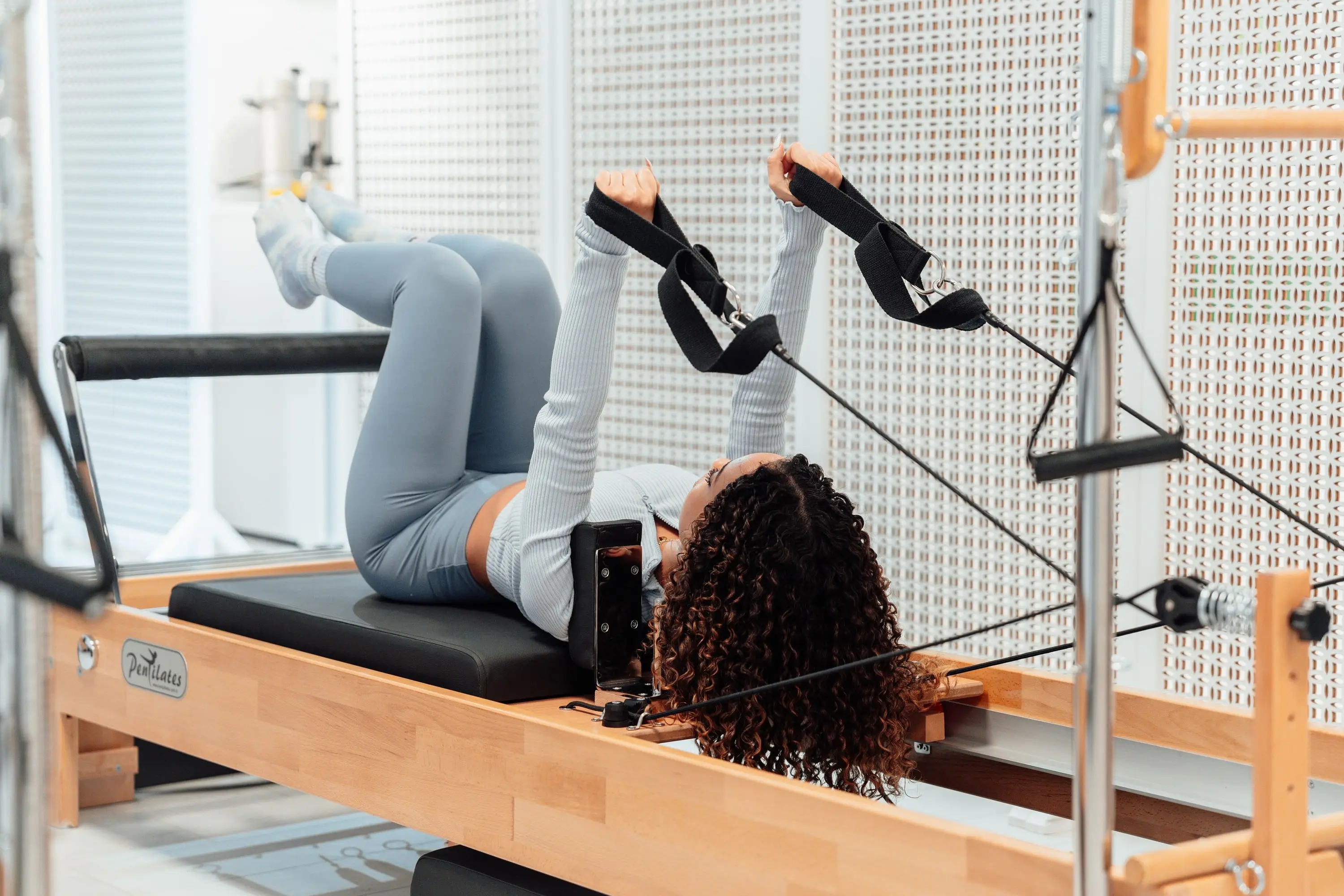
A muscle attaches to bone at both ends. Those attachment points do not move. Absent surgery, the distance between them is fixed by the skeleton, and no amount of exercise changes it.
So when a studio tells you a class will lengthen your muscles, it is describing something that cannot happen. And when it offers you a longer, leaner muscle as a result, it is offering you a different skeleton.
I say this at some point in most first sessions and it always lands slightly badly, because it sounds like I am taking something away. I am not. The real explanation is better, it just takes four paragraphs instead of three words.
But I genuinely feel longer
You do, and you are not imagining it. Several real things are going on.
Your resting muscle tone changed. Muscles have a baseline level of low-grade contraction, set by the nervous system rather than by the tissue. Chronically guarded hip flexors are not short — they are on, all the time, quietly. An hour of controlled movement and breathing turns some of that down. You did not lengthen anything. You stopped holding it.
Your joint position changed. Most people who feel short in the front of the hip are standing with the pelvis tipped forward and the ribs flared. Reorganise those two things and you will stand two centimetres taller on a measuring stick, because you have stacked your bones differently. That is real, measurable, and nothing to do with muscle length.
Your tolerance to stretch changed. This is the one that surprises people. A great deal of what limits your range is not tissue at all — it is your nervous system deciding that a position is unfamiliar and applying the brakes. Regular exposure to a position under control tells it the position is safe, and the brakes come off. Your hamstring did not get longer. Your brain got less worried about it.
Some tissue did adapt. Over months, under load, at length, muscles can add sarcomeres in series. This is genuinely a thing. It is slow, it is modest, and it is nowhere near responsible for what you felt after your first class.
Why the phrase persists
Because it sells, and because it does a second job that nobody says out loud: it promises a particular kind of body while sounding like it is talking about function. “Long and lean” is a body shape. Dressing it up as anatomy lets a studio sell an appearance while appearing to sell health.
That is the part I object to. Not the inaccuracy — plenty of useful teaching cues are technically inaccurate, and “reach your leg long” is a perfectly good instruction that produces exactly the movement I want. The problem is the promise. A cue helps you move. A promise about what your body will look like afterwards is a different thing entirely, and this industry has been making it for thirty years to people who deserve better.
What I say instead
That you will get stronger in ranges you currently avoid. That things which currently ache may ache less, because you will spend less of the day braced. That you will probably stand differently, and people will notice before you do. That the reformer is very good at loading a muscle at its long end, which is a genuinely useful and slightly unusual property of the equipment, and that this is the actual reason it works.
None of that fits on a poster. It has the advantage of being true.
A footnote for anyone who has been told they are tight
Being told your hamstrings are tight for twenty years is its own injury. It becomes a fact about you, and it makes you cautious in exactly the way that keeps the range small. If that is you, the most useful thing I can offer is that “tight” is very often a description of guarding rather than of tissue, and guarding responds to being made to feel safe — which takes weeks, not a lifetime, and is best done somewhere unhurried.
More from the journal
The timetable is not the problem
Every studio in this city publishes a timetable and hopes. Here is why that does not work, and what we did about it.
What the springs are actually doing
Nearly everybody assumes more springs means harder. Very often it means the opposite, and understanding why changes how you use the machine.