·5 min read
What the springs are actually doing
Nearly everybody assumes more springs means harder. Very often it means the opposite, and understanding why changes how you use the machine.
by Priya Raghunathan, senior instructor
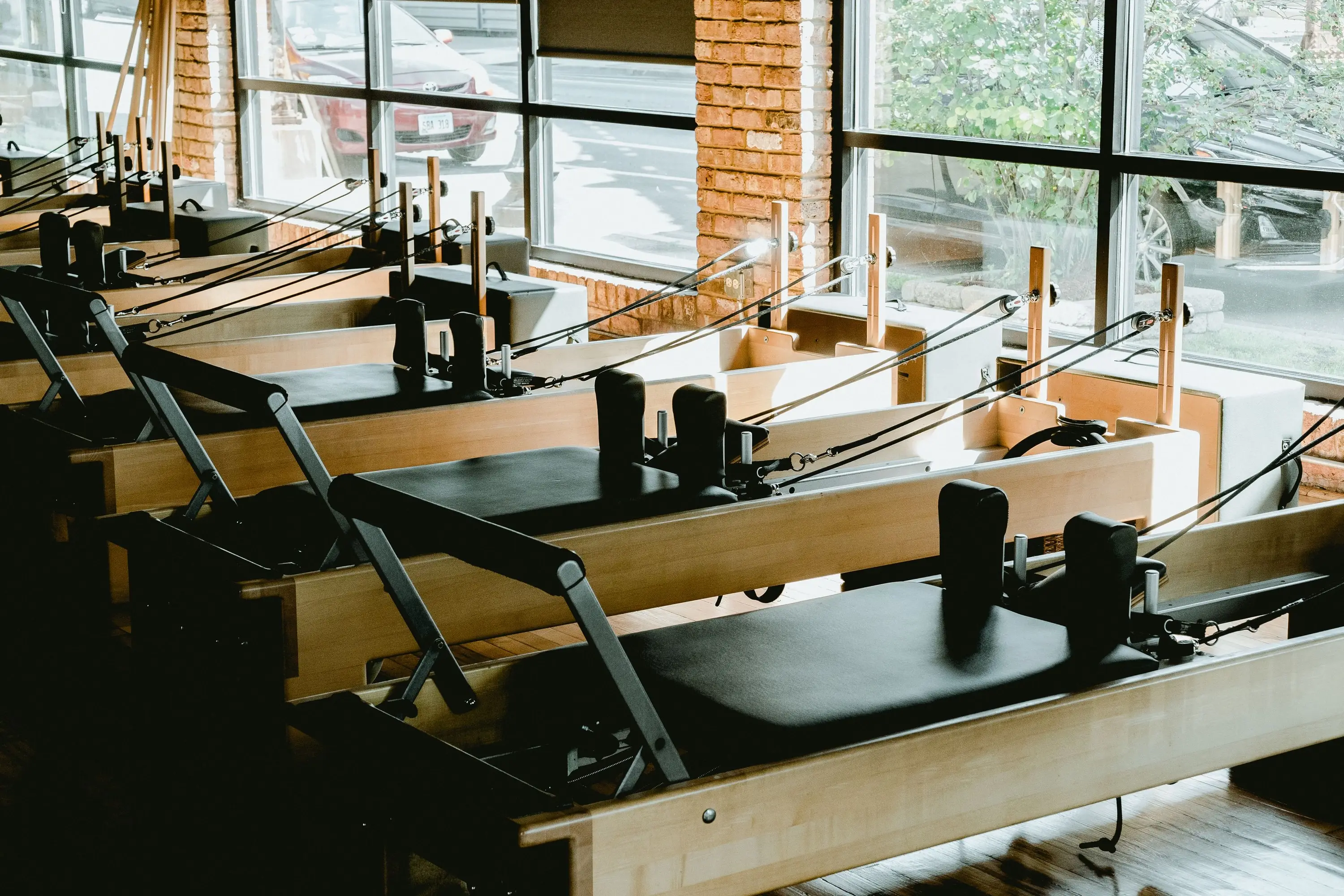
In your first month somebody will tell you to take a spring off, and you will hear it as being sent down a level. It is one of the most persistent misunderstandings in the studio, and it is entirely the machine’s fault for looking like a weights bench.
A reformer is not a weights bench. The springs do not always oppose you. Half the time they are helping.
Two situations, opposite rules
When you push the carriage away from the springs — footwork, leg press, anything where you are moving away from the spring anchor — the springs resist you. More spring, harder. This is the intuitive case, it is the first thing you do in every class, and it is where the assumption gets formed.
When you move with the springs, or hang off them — most strap work, most kneeling and standing work, anything where the spring is taking part of your body weight — the springs support you. More spring, easier. Fewer springs means less support, more of your own weight to manage, and considerably more work for everything trying to keep you stable.
So “take a spring off” in long stretch is not a demotion. It is the hardest version of that exercise, and being offered it is a compliment. Meanwhile a beginner on a heavy spring in the same position is being held up by the machine, which is exactly right and exactly what they need.
Why this matters for how you feel about the class
Because it means you cannot read the room. You will look across at somebody on two red springs while you are on one and conclude they are working harder than you. Depending on the exercise, the opposite may be true. Spring load is not a score, and nobody who has taught for more than a year reads it as one.
It also means the honest answer to “which spring should I be on” is that it depends on the exercise, your leverage, your limb length, and what we are trying to make you feel — which is why we would rather you asked than guessed, and why being told to change is not a judgment.
The other thing springs do
A spring’s resistance changes through its range. It is easy at the start of the movement and hardest at the end, when the spring is most stretched. This is almost the exact opposite of a dumbbell, which is heaviest where your leverage is worst.
That property is the reason the reformer works so well for people coming back from something. The load is lightest where the joint is most vulnerable and builds as you get into a stronger position. You cannot get that from a weight and you cannot get it from a resistance band, which is uniformly nasty at the end of its range. Joseph Pilates arrived at this in the 1920s largely by intuition and a lot of bed frames, and it took the biomechanics literature another sixty years to explain why he was right.
What to do with this
Ask. That is genuinely the whole practical takeaway. When somebody says to change your springs, ask what it will change — every instructor in this building will be delighted, because it means somebody wants to understand the machine rather than survive it.
And stop looking at what the person next to you is on. It does not mean what you think it means.
More from the journal
The timetable is not the problem
Every studio in this city publishes a timetable and hopes. Here is why that does not work, and what we did about it.
You cannot lengthen a muscle
"Long and lean" is the most repeated promise in this industry, and the anatomy behind it is simply wrong. What is really happening is more interesting.