Small studio·55 minutes·6 people
Rehab & Recovery
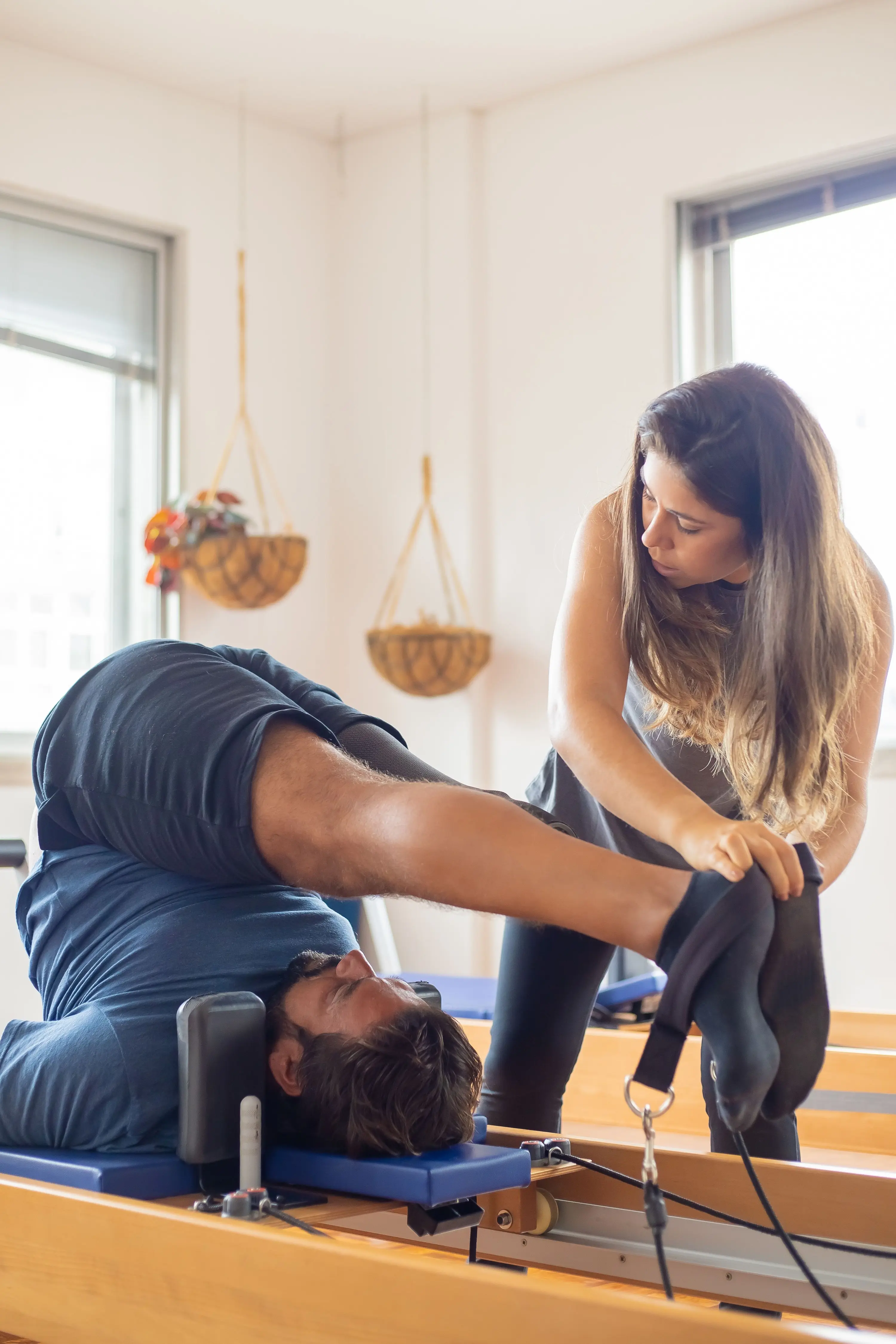
Six people, fifty-five minutes, slower than anything else we run. A movement class in a small room — not a clinic.
This class isn’t
for you if…
Rehab & Recovery is not for you if you are in acute pain right now, if something is numb, weak or getting worse, or if you have not yet had whatever it is looked at by somebody qualified to look at it. We are not that person and this class is not that appointment — see a GP or a physiotherapist first and come to us after. It is also not for you if you want to work hard; it is the slowest fifty-five minutes on the timetable and that is the entire design.
If that describes you, don’t book Rehab & Recovery —let the router find the right one, orask us. Nobody here is on commission.
Who it is for
Your back or your neck is an ongoing background noise rather than an emergency. You sit down for a living and it shows. You have finished with a physiotherapist and been told to keep moving, and you would like that to happen somewhere with six people in the room rather than twelve. It is also the class we put people in who are simply nervous, whatever the reason.
What fifty minutes of it feels like
Unhurried to the point of feeling almost like nothing for the first two weeks, then suddenly like the most useful thing in your week. A lot of it is done lying down. Ruth talks constantly and asks you questions rather than telling you how it should feel. People are often quite tired afterwards in a way they cannot account for.
First, plainly: what we are not
Halcyon is a pilates studio. It is not a physiotherapy clinic, and this class is not treatment.
We do not diagnose anything. We do not treat, cure or rehabilitate any condition, and if you find a sentence anywhere on this website that suggests otherwise, please tell us and we will delete it. Nobody who teaches here is a physiotherapist, an osteopath or a doctor. Ruth has trained in equipment work designed with physiotherapists, which is a genuinely useful thing and is not the same as being one.
What this class actually is: fifty-five minutes of carefully chosen movement in a room small enough that one instructor can watch six people properly.
What we can help with
- Getting you moving regularly again when a back or a neck has made you cautious about moving at all
- Building strength around a joint or a spine that has been avoided for a while
- Keeping up the kind of work a physiotherapist has already given you, in a place with the equipment for it
- The specific, boring, extremely common problem of sitting at a desk for nine hours and having hips and a mid-back that have stopped participating
- Confidence, which is not a small thing. A lot of long-term back pain comes with a well-earned fear of doing the wrong movement, and doing controlled movement in a room where somebody is watching is often the part that actually shifts
What we cannot help with
- Anything undiagnosed. If you do not know what is wrong, we are the wrong first stop
- Pain that is severe, getting worse, or waking you at night
- Numbness, pins and needles, or weakness in an arm or a leg
- Any loss of bladder or bowel control, or numbness around the saddle area — this one needs urgent medical attention today, not a class next Tuesday
- Pain after a fall, an accident, or an impact
- Anything you are currently having investigated, until whoever is investigating it has told you what you may do
Who to see instead
A GP if the pain is new and you do not know what caused it, if it is severe or worsening, if you have any of the red-flag symptoms above, or if you feel generally unwell with it. In the UK you can also self-refer to NHS physiotherapy in most areas without seeing a GP first.
A physiotherapist if you have a diagnosis and want hands-on assessment and a programme built for you specifically. This is the right answer far more often than studios like ours admit. We keep a list of three local practices at reception and we hand it out several times a month. There is no arrangement between us and none of them pay us anything.
A women’s health physiotherapist for anything involving the pelvic floor, during or after pregnancy.
Us, afterwards. The most useful thing we do is the year after the physio finishes, when the exercises are still working and doing them alone in a bedroom has stopped happening.
What actually happens in the class
Ruth asks everybody how the week has been before anything starts, and adjusts. Then: breathing, some very small range work on the tower or the reformer at light spring, side-lying hip work, and controlled loaded movement that gets slightly less controlled and slightly more loaded over the months. Nothing is held to a count that somebody else set.
If something hurts, you say so and it stops. That is not a disclaimer, it is the instruction — the class only works if you are willing to interrupt it.
If that is not it
Foundations
The first six weeks. You learn the machine before you learn the workout.
Reformer Flow
The everyday class. Continuous, cued rather than demonstrated, and it assumes you know the machine.
Tower & Chair
Six people, springs instead of momentum. The quietest hard thing on the timetable.